
Every enterprise has built infrastructure for code, for data, and for financial controls. No one has built infrastructure for tracking decisions. That is what Spheresmith is for.
The infrastructure gap no one is thinking about
Organizations have spent decades building infrastructure for code (version control, CI/CD, testing), for data (lineage, catalogs, governance), and for money (ERP systems, audit trails, controls). But decisions, the actions that determine what gets built, who gets hired, what gets approved, have no comparable infrastructure.
Generative AI has made this gap urgent. AI-assisted decisions are now happening at scale, often invisibly, and without documentation, audit trails, or feedback loops even in regulated industries where scrutiny is inevitable.
Decision Infrastructure is the missing layer: a system that treats decisions as first-class objects, captures the full decision record, anchors it to its underlying data and policy context, routes it through appropriate governance, and tracks outcomes over time. It provides the infrastructure that makes AI-assisted decisions defensible, repeatable, and continuously improvable.
The shift is already underway. We believe a new category is emerging: AI-driven Decision Intelligence: The future of work centered on durable, governed decision artifacts rather than chats or copilots.
Decision Intelligence, as a category, provides the AI governance and accuracy that enterprise, fund, and domain-specific use cases require, while leveraging existing Systems of Record and analytics. Foundational model companies are moving to become the system of engagement for all use cases. Decision Intelligence is what ensures that the decisions they touch remain governed, traceable, and specific to the organization making them.
Decision Intelligence is built around three layers
The Decision Record (the foundational artifact)
A durable, structured record of the decision itself: what was decided, by whom, using what information, under which policies, and at what point in time. This establishes the decision as a first-class object. Not a chat transcript or a summary, but a formal artifact.
The Decision Context (what the record is anchored to)
The full context that makes the decision defensible and reproducible: applicable regulatory guidelines, domain ontologies, and the exact point-in-time state of the underlying data.
Point-in-time context is critical. A decision made on a weekend after conversations and adhoc access to enterprise systems must be reproducible and explainable months later in front of a regulator. Reproducibility requires capturing not just the conclusion, but the precise data state and policy framework that informed it. This is where Systems of Record and MCP-style access matter, not as integration features, but as mechanisms for verifiable context capture.
The Decision Lifecycle (from judgment to institutional knowledge)
The governance and feedback layer: approval chains, cascading memos, outcome tracking against defined metrics, and policy updates triggered by results.
The goal is to convert one-time judgments into institutional knowledge, enabling post-decision reviews, counterfactual (“what-if”) analysis, and continuous improvement. Decisions should not disappear after execution; they should compound in value over time.
What a Decision Intelligence system must be
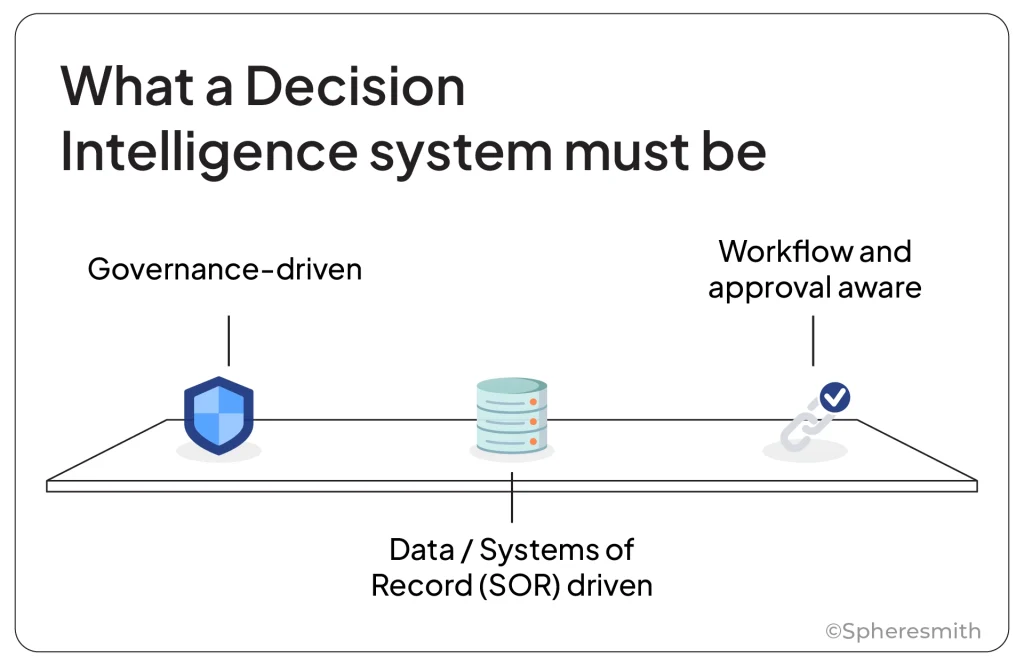
A system delivering these three layers of Decision Intelligence needs to be:
Governance-driven: grounded in enterprise beliefs, principles, policies, processes, roles and permissions, with full auditability.
Data / System-of-Record (SOR) driven: built on verifiable data lineage, domain ontologies, regulatory constraints, and point-in-time data states, leveraging Ask and MCP-style access to Systems of Record (not just API calls).
Workflow and approval aware: enabling closed-loop decision narratives with structured approvals and traceable outcomes.
Meet Spheresmith
Spheresmith is an AI-native Decision Intelligence company that enables organizations to make governed, accurate, and auditable decisions with continuous post-decision monitoring aligned to enterprise-specific (or fund-specific) policies and guidelines.
Spheresmith initially demonstrated its AI platform in the investment domain, one of the most demanding decision environments, focusing on asset-class decision-making for General Partners (GPs) and Limited Partners (LPs). It is now expanding into corporate use cases, beginning with finance and operations. The decision infrastructure requirements are the same: governed, accurate, and auditable decisions made against domain-specific knowledge, across multiple Systems of Record, with full traceability. What changes with each use case domain is the domain ontology and the regulatory context.
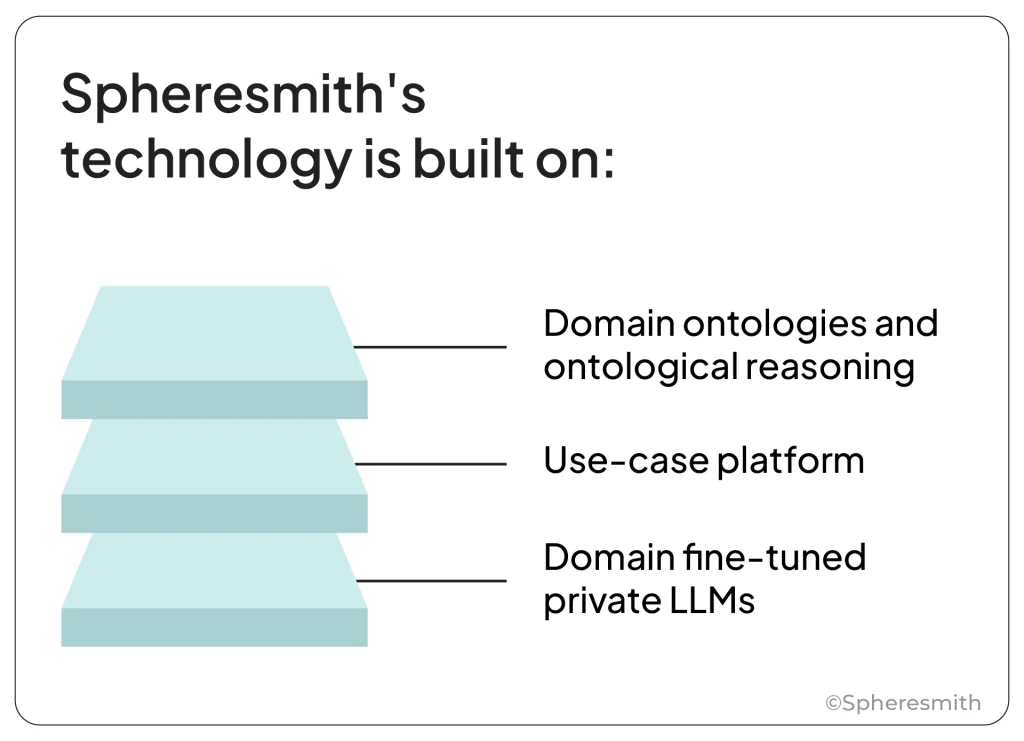
Spheresmith’s technology is built on:
- Domain ontologies and ontological reasoning to structure enterprise and sphere (domain) knowledge
- A use-case platform that generates consistent, accurate (for qualitative and quantitative data) and explainable decision artifacts and the workflows that follow the decision
- Domain-fine-tuned private LLMs optimized for auditability, cost control, and performance
Spheresmith’s primary value lies in making high-quality decisions across multiple Systems of Record while minimizing integration friction. The company has demonstrated rapid onboarding and time-to-value in the investment domain and is applying the same approach to corporate environments.
We are at the beginning of this transformation. The decisions being made today, in regulated industries, in investment committees, in finance and operations teams, are happening without infrastructure. Spheresmith is building that infrastructure. If you are building enterprise AI and decisions are at the centre of what you do, we would like to talk.