
Enterprise AI needs to produce decisions that are explainable, auditable, and repeatable, not just fluent. Most contemporary enterprise AI systems are designed to reason about data, not about decisions and their operational consequences. These systems operate within narrow task boundaries, optimize for local objectives, and treat decisions as final outputs rather than as commitments embedded in longer decision trajectories.
AI executes tasks. It does not yet make decisions in spheres.
Today’s AI systems may execute each analytical step correctly yet still fail where it matters most: delivering coherent, accountable outcomes over time. What we need is not one time decision, but a structured outcome that resolves key questions and triggers near-term actions, shapes future choices, updates assumptions and policies, and drives downstream workflow execution. Such a system becomes the future system of engagement for a class of workers involved in high impact decisions on revenue, money or life.
Decision Intelligence addresses this gap by shifting the focus from isolated predictions and tasks to the coherence of decision narratives. A decision narrative is a decision artifact and the workflows that are driven by that decision. This should not be confused with decision traces which reflect an attempt to automate decision-making by guessing causality based on changes to Systems of Record. Decision Intelligence asks whether a single or sequence of judgments makes sense as a whole, given its intent, assumptions, constraints, and evolving context; it defines work as a set of decision narratives and the workflows/actions that follow each instance of the decision, rather than a series of disconnected tasks.
The unit of work is not a task. It is a decision.
Traditionally, ontologies have represented domain knowledge in spheres. An ontology is not the same as a data model or a catalog. It is the representation of knowledge to deliver use cases in spheres or domains. Ontologies have been around for 50 years and have traditionally failed because they are static and not enterprise-specific. Early attempts to capture domain knowledge in ontologies failed to gain broad adoption. Most of the research in Ontologies stagnated since Google released the Attention paper because Generative AI allowed a system to produce reasonable artifacts, without understanding domain knowledge. However, the failings of LLMs became apparent when enterprises ventured seriously into decision-making with information in Systems of Record. At Growthsphere, we experienced serious issues with state-of-the-art LLMs around completeness, consistency, prompt complexity, standardization, explainability, auditability, domain-gap, cost, numerical, performance and change-management.
As part of Growthsphere’s work in investment decision-making, we developed a differentiated approach that augments LLMs with ontologies to overcome the limits of state-of-the-art AI and produce high-quality decision artifacts that directly drive workflow actions.
This method, ontological reasoning, structures domain knowledge, data, and policy so outputs are consistent, explainable, and operationally usable. At Growthsphere we demonstrated an aggressive time-to-value by onboarding all of our LPs/GPs in a day across ~40 clients. This learning forms the technical and conceptual foundation of Decision Intelligence.
With Spheresmith we are extending this learning towards other spheres, the first new sphere being Corpsphere (for finance and operations).
We believe the future of work for organizations managing significant capital or large workforces will be defined by AI-generated decision narratives, embedded workflows, and governed human approval.
Decision Intelligence is built around three layers.
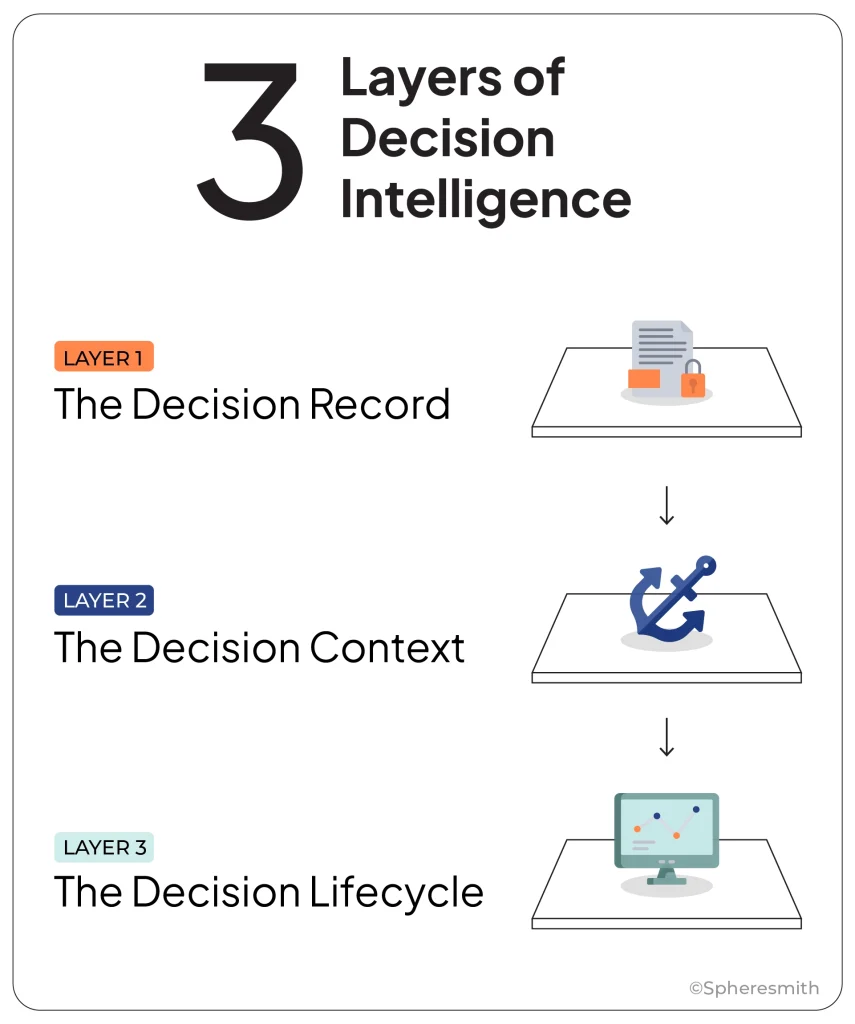
The Decision Record is the foundational artifact: a durable, structured record of the decision itself — what was decided, by whom, using what information, under which policies, and at what point in time. This establishes the decision as a first-class object, not a chat transcript or a summary, but a formal artifact.
The Decision Context is what the record is anchored to: the full context that makes the decision defensible and reproducible, including applicable regulatory guidelines, domain ontologies, and the exact point-in-time state of the underlying data. Point-in-time context is critical. A decision made on a weekend using conversational access to enterprise systems must be reproducible and explainable months later in front of a regulator. Reproducibility requires capturing not just the conclusion, but the precise data state and policy framework that informed it. This is where Systems of Record and MCP-style access matter, not as integration features, but as mechanisms for verifiable context capture.
The Decision Lifecycle is the governance and feedback layer: approval chains, cascading memos, outcome tracking against defined metrics, and policy updates triggered by results. The goal is to convert one-time judgments into institutional knowledge, enabling post-decision reviews, counterfactual analysis, and continuous improvement. Decisions should not disappear after execution; they should compound in value over time.
Decision Narrative deep-dive
What a real decision looks like: a CFO, a memo, and a chain of consequences.
Consider a CFO conducting a mid-quarter assessment of the business. To do this, they typically rely on multiple systems: planning tools such as Anaplan; ERP systems like NetSuite that capture current revenue and costs; and operational systems (CRM, service, and HR) that reflect customer health, churn, failures, revenue per employee, and workforce costs. External benchmarks are also critical to understand whether observed performance trends are company-specific or reflective of broader peer dynamics.
From this analysis, the CFO produces a decision narrative, often in the form of a memo. For example, the memo may conclude that a particular geography is underperforming. That single decision artifact then triggers a downstream action, such as a request to increase Marketing Qualified Leads (MQLs) through targeted campaigns. This campaign becomes a secondary decision narrative, explicitly linked to the original CFO decision, and proceeds through its own approval workflow.
Once approved and executed, the outcome must be tracked and measured to determine whether MQLs actually improve. Over time, the organization accumulates a set of decision narratives that are auditable, repeatable, and explainable, and that can be evaluated longitudinally for effectiveness and learning.
One approval triggers another. That is the point.
In practice, Decision Intelligence systems model work not just as tasks or roles, but as the decisions people make and the workflows they initiate, approve, or are required to execute.
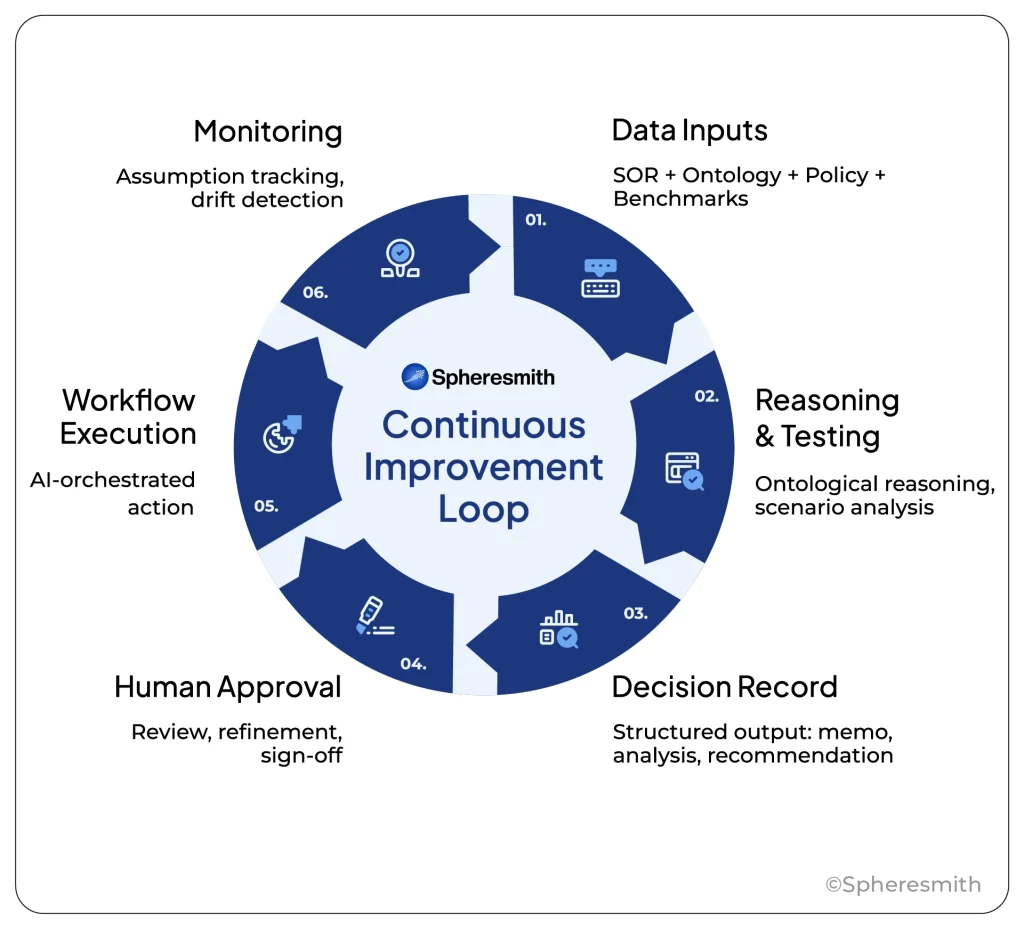
The first step is to turn every decision into a structured artifact, capturing inputs, assumptions, sources, policies, and reasoning, so outcomes are transparent, auditable, and repeatable instead of dependent on individual judgment. AI can then create and maintain decision artifacts like memos and analyses, send them through human approval, and activate downstream workflows once decisions are approved.
The decision does not end when it is approved.
Each decision narrative is grounded in the current state of the business as reflected in Systems of Record, enriched by external benchmarks and peer performance data, and pressure-tested through scenario planning and forward projections. The system can continuously assemble this context, pulling financials, operational metrics, pipeline, usage, risk signals, and market comparables, to frame decision options and quantify trade-offs before a choice is made. Once a decision is approved, the system does not stop at execution; it actively monitors the assumptions, thresholds, and policy constraints that supported the decision, watching for drift, benchmark divergence, or rule violations. When assumptions begin to break or policy limits are crossed, the system can automatically surface exceptions, trigger reviews, and recommend corrective actions, turning decisions into living, monitored commitments rather than one-time judgments. As this loop matures organizations can increase effectiveness one decision narrative at a time.
Shift from Chat and Copilots to Decision Systems
2025 was the year of the copilot. 2026 is the year of the decision.
2025 was dominated by authoring and chatbot platforms. Tools like Cursor, Claude Code and Lovable generated code, Harvey, Claude Cowork and similar systems drafted legal documents, Sierra scaled conversational agents, and Perplexity focused on AI research workflows. At the same time, most systems-of-record vendors added “Ask AI” interfaces & MCP models so users could query data without needing to understand APIs or underlying data models.
The 2026 shift moves beyond authoring toward decision artifact generation and policy-aware execution, what we call decision narratives.
While early winners embedded domain knowledge into broadly capable agents, real enterprise decision narratives require combining domain models, systems-of-record data, policy constraints, and definitions of good vs. bad outcomes by industry or firm, which is why ontology-driven approaches are becoming central.
Enter Spheresmith: Becoming a category leader in Decision Intelligence
Spheresmith is building the infrastructure that decisions have never had.
Following extensive discussions and diligence with leading AI technologists and domain experts, we chose to expand our Decision Intelligence framework beyond investing into enterprise operations, and finance. Since then, we have validated the approach through active engagement with large pension funds, public sector organizations pursuing AI enablement, and corporations seeking decision-to-execution automation. These domains share the same core challenge: complex, high-stakes decisions that must be codified, justified, and executed through governed workflows.
Spheresmith’s primary value lies in making high-quality decisions across multiple Systems of Record while minimizing integration friction.
The company has demonstrated rapid onboarding and time-to-value in the investment domain and is applying the same approach to corporate environments.
| We believe Decision Intelligence represents a trillion-dollar category opportunity with the potential to materially reshape how domain & role specific decisions are made and operationalized through workflows. |