Is your team using AI to improve and streamline their work? The answer is yes. The better question is whether anyone is governing that work.
A GP sends over a 140-page quarterly letter. Your analyst drops it into Claude, pastes the summary into the IC memo draft, and moves on. Fifteen minutes instead of two days.
The work is faster. The work is also completely ungoverned.
No one logged the model. No one verified the figures. No one can reproduce the reasoning six months from now when the board asks how that commitment was reached. The decision happened and it left no trail.
This is already inside your investment process. The question is whether it is governed or accidental. The Gearbox research calls this the gap between what a fund’s policies require and what its operating layer can actually deliver. AI is not closing that gap. Right now, for most funds, it is widening it.
01
The Evidence
Most AI tools in this space are built on generic large language models. They are powerful, but they are general purpose. They do not know what a fund is, what its mandate requires, or how its portfolio is structured. They treat every question as a fresh conversation with no institutional memory.
Governing AI requires something fundamentally different: a reasoning architecture that encodes the fund’s own identity, data relationships, and decision logic before any output is produced. That architecture is called an ontology.
An ontology is a structured map of how concepts relate to each other within a specific domain. In institutional investing, that means encoding the relationships between asset classes, strategies, risk factors, mandate constraints, and portfolio structures before any reasoning begins.
We tested this directly. Given the same source data, the same prompt, and the same output template, we compared a memo produced through an ontology-guided pipeline against one produced by a pure-LLM chat session. The scope question was a mid-quarter investment assessment: a deliberately federated query that cannot be answered from any single system, requiring joins across portfolio accounting, performance reporting, risk analytics, and external benchmark data.
Fabricated cells, columns and peer financials; imputed cross-system actuals. Values that look authoritative but were never in the source data.
Silent omission of the largest region from a regional plan. Truncated deal lists. Dropped scenarios. Sections merged against explicit instructions to keep them separate.
Totals that do not reconcile. Back-fitted weekly values. Regional allocation buckets summing to 126.7%. Arithmetic errors that propagate through dependent calculations.
Error propagation across dependent sections. Wrong weekly values feed wrong cumulative percentages, which feed a wrong divergence-point conclusion. Each section appears locally consistent. The error chain is invisible to a reader auditing one section at a time.
By the time a decision-maker reads the recommendation, the foundation of the analysis has been compromised in ways that are no longer visible at the surface. That is the fiduciary risk the Gearbox paper warns about: a tool that does not change decisions does not re-machine the gears. An ungoverned AI tool changes decisions in ways no one can trace.
02
THE THEORY
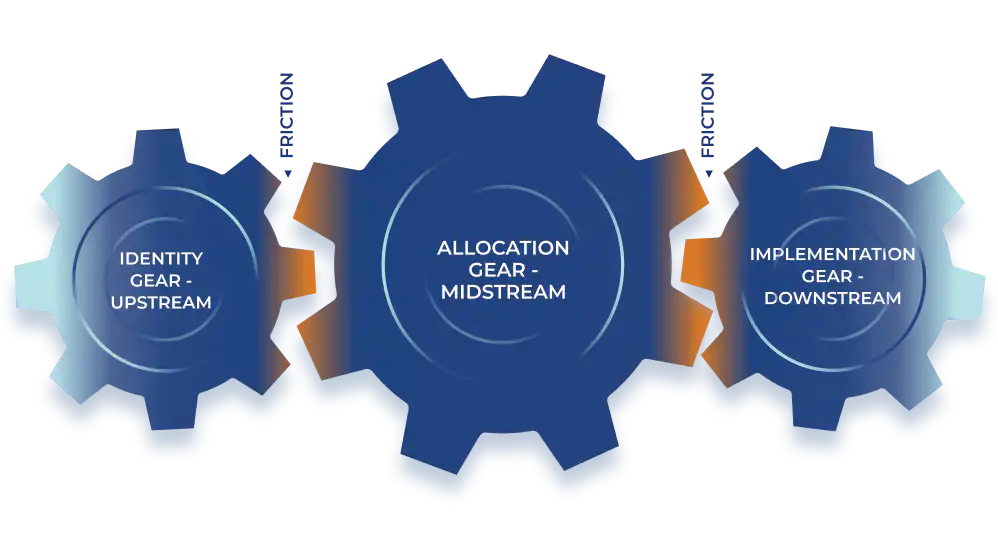
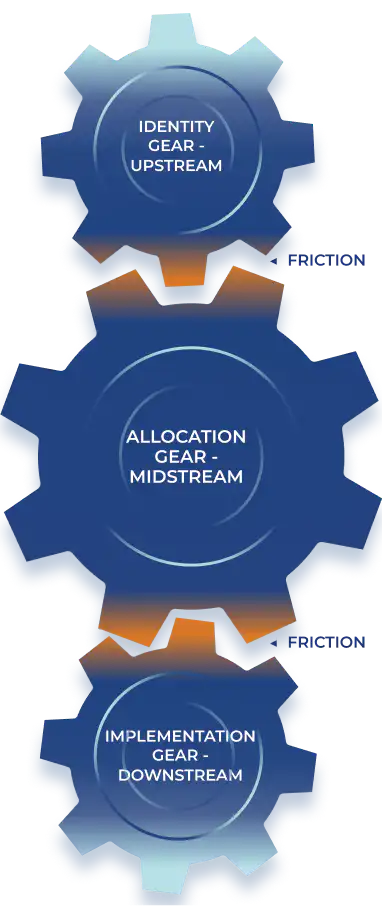
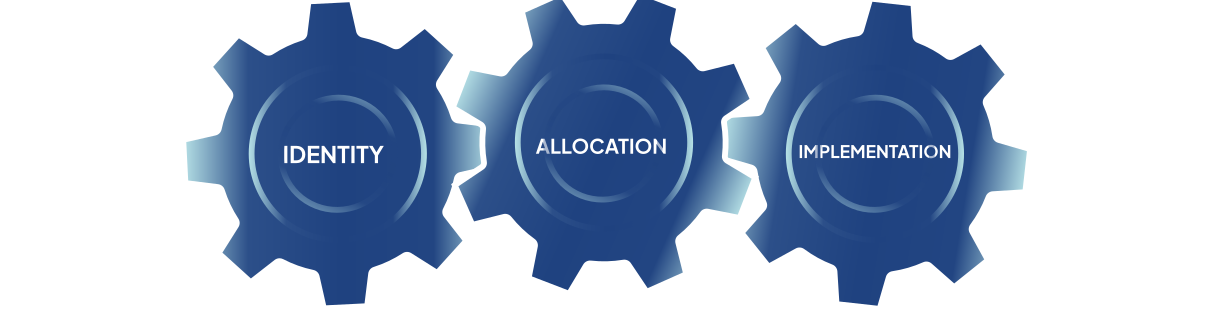
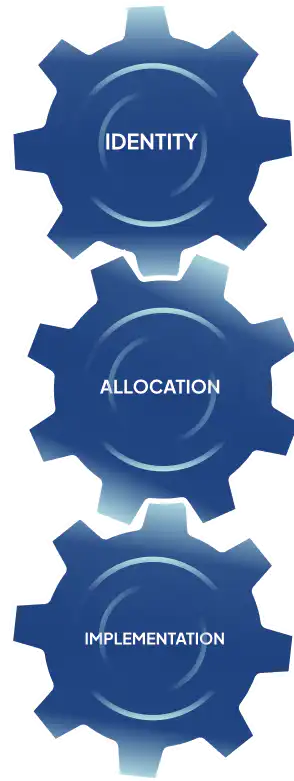
Drawing on five years of fieldwork and 35 case studies, my co-authors (Rook and Sharma) and I argue that every asset owner is a gearbox: an internal transmission that converts sponsor purpose into deployed capital. Three gears do the work. They share teeth. Spin one, and the others must turn with it.
When decisions have infrastructure, the gears stop grinding
Identity Gear · Upstream
Allocation Gear · Midstream
Implementation Gear · Downstream
In mechanical systems, you rarely pair a gear the size of a pizza with one the size of a dime: the smaller gear must spin far faster to keep up, concentrates stress at the teeth, and is more prone to wear and breakage.
In many funds, identity is the dime-sized gear: small team, constrained governance bandwidth, limited capacity. When that small upstream gear is asked to mesh with pizza-sized allocation demands, friction becomes the default outcome.
Eric Dyer, Chief Revenue
Officer, Spheresmith
03
THE GRIND
Why most technical catalysts fail
Of the five catalysts that can temporarily loosen a hardened gearbox (transparency, crisis, extra-financial mandates, collaboration, technology), technology is the most frequently misapplied. Asset owners confuse investment technology with IT hygiene. They buy tools. They procure dashboards. They stand up innovation labs. Decisions continue to be made the way they always were. The Gearbox paper calls this innovation theater: visible activity, unchanged gears. A tool that does not change decisions does not re-machine the gears. It uses up the catalyst window.
Trust
Transparency
Governance
AI outputs enter the memo without verification. Hallucinated figures, missed risks, or misframed comparisons propagate through the IC process. If you cannot trust the numbers and you cannot trust the commentary, you can do nothing with the results. Bad data produces bad artifacts, and bad artifacts produce bad decisions.
No citation trail from output back to source data. No provenance for any decision. When the board, a regulator, or a beneficiary asks how a decision was reached, the fund cannot reconstruct the reasoning. As AI enters the decision process, full traceability and auditability become fiduciary requirements, not features.
There is no process where stakeholders can approve, review, or challenge how AI is being used. Decision rights, delegation thresholds, and review processes were designed for a world where humans did all the reasoning. AI changes the core process without changing the governance around it. The committee votes on reasoning it cannot inspect.
Trust
AI outputs enter the memo without verification. Hallucinated figures, missed risks, or misframed comparisons propagate through the IC process. If you cannot trust the numbers and you cannot trust the commentary, you can do nothing with the results. Bad data produces bad artifacts, and bad artifacts produce bad decisions.
Transparency
No citation trail from output back to source data. No provenance for any decision. When the board, a regulator, or a beneficiary asks how a decision was reached, the fund cannot reconstruct the reasoning. As AI enters the decision process, full traceability and auditability become fiduciary requirements, not features.
Governance
No citation trail from output back to source data. No provenance for any decision. When the board, a regulator, or a beneficiary asks how a decision was reached, the fund cannot reconstruct the reasoning. As AI enters the decision process, full traceability and auditability become fiduciary requirements, not features.
Governance
There is no process where stakeholders can approve, review, or challenge how AI is being used. Decision rights, delegation thresholds, and review processes were designed for a world where humans did all the reasoning. AI changes the core process without changing the governance around it. The committee votes on reasoning it cannot inspect.
04
War of Currents
The gearbox metaphor itself may not go far enough. AI is not simply another catalyst trying to loosen hardened gears. It is doing to the investment decision process what the electric motor did to gear-driven industrial machinery: changing what the gears even mean.
Before electrification, factories ran on a single power source, a steam engine or water wheel, transmitted through an elaborate system of shafts, belts, and gears spanning the entire building. The electric motor did not improve that transmission. It replaced it. Each machine got its own motor. The gears that once connected everything became unnecessary. The entire architecture of production changed.
AI carries the same potential inside an asset owner. The elaborate human transmission chain exists only because cognition did not scale: an analyst reads the document, summarizes it for an associate, the associate formats it for a VP, and the VP frames it for the investment committee. AI changes that constraint, because it makes cognition scale in a way human teams never could. The question is no longer whether the gears will be re-machined. The real question is whether the institution recognizes that the machine itself is changing beneath them.
History offers a useful lesson here. Before electrification matured, the industry went through the War of Currents. Edison’s direct current worked for small-scale, in-building applications. It was simple, accessible, and adequate for lighting a single city block. Yet DC could not transmit power at distance, and it could not run a factory floor. Tesla’s alternating current was what industry actually required: scalable, efficient, and powerful enough for real work.
Generic LLMs are direct current. ChatGPT, Copilot, Grok. They work for small-scale, individual use. An analyst summarizing a single document. A quick question answered. Adequate for lighting one block of the workflow. Yet they cannot transmit governed reasoning across an entire book of record, maintain identity alignment at institutional scale, or produce outputs strong enough for fiduciary use.
Ontology-powered AI is alternating current. It is what institutional decision-making actually requires: structured reasoning that scales across systems, grounded in the fund’s own data, governed by the fund’s own policies, and auditable end to end. That is the difference between a productivity shortcut and a decision architecture. That is what Spheresmith built.
The War of Currents, replayed inside the fund
Al is doing to the investment decision process what the electric motor did to gear-driven machinery.

05
THE PRACTICAL TAKEAWAY
The Gearbox paper prescribes a clear test for whether a technology catalyst is actually re- machining the gears or merely consuming the catalyst window. A tool must be identity-aligned, auditable end-to-end, bias-visible, memo-native, and governance-legible. InvestSphere was built to pass all five.
Spheresmith’s InvestSphere is an ontology-aware reasoning layer, not a generic AI wrapper. It is the difference between an analyst using Claude on their laptop and an institution deploying a governed decision layer that operates on its own IPS, beliefs, and constraints.
Encodes the fund’s mandate, sectors, geos, thresholds, red flags, and memo templates. Every output reflects the institution, not the vendor.
Connects into books of record and unstructured documents. Every output anchored to source. Zero hallucinations by architecture.
IC, screening, and DD memos auto-assembled from PPMs, DDQs, quarterly letters, and fund databases. Committee-ready, in the fund’s own tone and format.
After Spheresmith, the three gears turn together. Identity, Allocation, and Implementation move in sync because decisions are governed, traceable, and grounded in the organization’s actual policies, not announced on paper and lost in execution.
06
THE CHANGE
The Gearbox paper is explicit: career risk is the human expression of mechanical friction. When the gears grind, individuals absorb the heat. InvestSphere reverses that equation, precisely for the institutions the research warns are most exposed: cost-conscious, long-tail allocators whose ambition outpaces operational capacity.
BEFORE
Weeks per IC memo
AFTER
per IC memo
BEFORE
analysts per deal
AFTER
Analysts Per Deal In the fund’s own voice and template
BEFORE
fragmented tools
per decision
AFTER
decision layer, full
citation trail
BEFORE
Adhoc, ungoverned
AFTER
governed, auditable, identity-aligned
This is Chapter 1 of a periodic series from Spheresmith on integrating AI into institutional investment decision-making. Each chapter functions as a standalone brief while building toward a comprehensive playbook for the transition from ungoverned AI adoption to fully integrated, governed decision intelligence.
Why AI is already inside your decision process.
Red-teaming deal flow with AI.
Governing the memo process.
Based exclusively on The Asset Owner Gearbox: Why Investment Innovation Grinds and How to Make It Turn (Monk, Rook & Sharma, 2026). Full citation map available on request.